
Origen e Historia
La Umbanda representa un fenómeno religioso genuinamente brasileño nacido a principios del siglo XX, manifestándose como una síntesis de elementos de la matriz africana, el catolicismo, el espiritismo europeo y los saberes indígenas. Dentro de este complejo entramado, la figura de Xangô emerge como una de las entidades más fundamentales, vinculando sus raíces directamente con la civilización yoruba de África Occidental. Históricamente, Xangô es identificado como el tercer rey de la ciudad estado de Oyo, en el actual Nigeria y Benin, donde su administración estuvo marcada por el poder militar y la implementación de leyes. Durante la diáspora transatlántica, el culto a este Orixá sobrevivió gracias a la resistencia cultural de las poblaciones esclavizadas, adaptándose a los nuevos entornos sociales de la tierra brasileña. En el contexto específico de la Umbanda, Xangô no es solo una deidad histórica, sino una fuerza activa de la naturaleza que personifica el equilibrio cósmico. Su evolución en el suelo brasileño permitió que se integrara en la jerarquía de las líneas espirituales, donde actúa como el señor de las montañas y el guardián de la ética moral y el orden social dentro de la estructura religiosa contemporánea.
Fundamentos Tradicionales
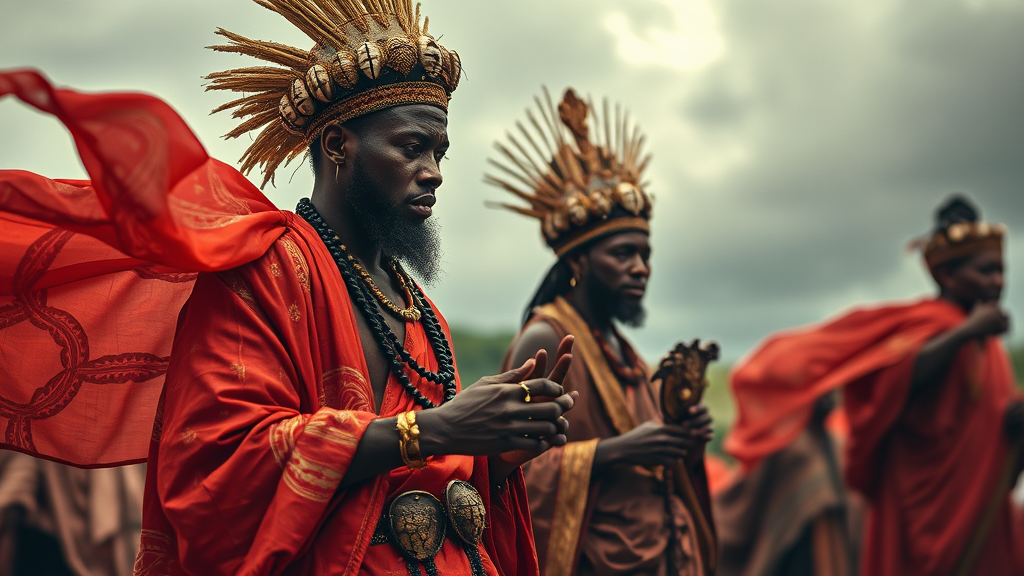
La base teológica de Xangô en la Umbanda se asienta en su dominio sobre los elementos naturales del rayo, el trueno y la piedra. El rayo simboliza la manifestación inmediata de la justicia divina, una fuerza fulminante que penetra la oscuridad para revelar la verdad. La piedra, representada frecuentemente por el granito, encarna la permanencia, la estabilidad y la inmutabilidad de las leyes que rigen el universo. Desde una perspectiva antropológica, Xangô representa el concepto de la justicia no como un castigo arbitrario, sino como un equilibrio inevitable que se restablece según el peso de las acciones humanas. Se le asocia con el color rojo, que simboliza el fuego purificador y la pasión, pero también la energía vital que impulsa la transformación. En la ritualidad, su presencia se manifiesta a través de la danza y el tambor la justicia, donde el ritmo busca alinear la frecuencia del individuo con la frecuencia del orden universal. Su arma característica, el doble hacha o axe, simboliza la dualidad del poder: la capacidad de destruir lo injusto para construir lo justo, manteniendo siempre la armonía entre los polos opuestos.
Importancia dentro de la Tradición
La relevancia de Xangô dentro de la Umbanda es vasta debido a su rol como la máxima autoridad moral en el panteón espiritual. Es el protector de los jueces, de los abogados y de todos aquellos que buscan la verdad y la resolución de conflictos en la esfera legal y social. Su influencia trasciende el ámbito religioso para convertirse en un pilar de la identidad cultural brasileña, recordando a los fieles la importancia de la integridad y la responsabilidad sobre la palabra. En las ceremonias de Umbanda, Xangô es quien dicta la limpieza de las energías negativas, asegurando que la malidad no prospere en el sagrado de la comunidad. Su presencia fomenta el desarrollo de la sabiduría y la justicia social, exigiendo a los practicantes una verdadera evolución que requiere corregir la conducta terrenal antes de elevar el espíritu. Al ser el rey de la justicia, Xangô garantiza que el destino de cada alma esté sujeto a las leyes del equilibrio ético, convirtiéndose en el guardián inquebrantable de la rectitud universal.
Origins and History
Umbanda represents a genuinely Brazilian religious phenomenon born in the early 20th century, manifesting as a synthesis of elements from the African matriz, Catholicism, European spiritism, and indigenous knowledges. Within this complex framework, the figure of Xangô emerges as one of the most fundamental entities, linking his roots directly to the Yoruba civilization of West Africa. Historically, Xangô is identified as the third king of the city-state of Oyo, located in modern-day Nigeria and Benin, where his administration was marked by military power and the implementation of laws. During the transatlantic diaspora, the cult of this Orixá survived thanks to the cultural resistance of enslaved populations, adapting to the new social environments of the land of Brazil. In the specific context of Umbanda, Xangô is not merely a historical deity but an active force of nature personifying cosmic balance. His evolution on Brazilian soil allowed him to be integrated into the hierarchy of spiritual lines, where he acts as the lord of the mountains and the guardian of moral ethics and social order within the contemporary religious structure.
Traditional Foundations
The theological foundation of Xangô in Umbanda is based on his mastery over the natural elements of lightning, thunder, and stone. Lightning symbolizes the immediate manifestation of divine justice, a striking force that penetrates the darkness to reveal the truth. Stone, frequently represented by granite, embarks permanence, stability, and the immutability of the laws that govern the universe. From an anthropological perspective, Xangô represents the concept of justice not as arbitrary punishment, but as an inevitable balance that is restored according to the weight of human actions. He is associated with the color red, which symbolizes purifying fire and passion, but also the vital energy that drives transformation. In ritual practice, his presence is manifested through the dance and the justice drum, where the rhythm seeks to align the individual's frequency with the frequency of universal order. His characteristic weapon, the double axe or axe, symbolizes the duality of power: the capacity to destroy what is unjust to build what is just, always maintaining harmony between opposite poles.
Importance within the Tradition
The relevancia of Xangô within Umbanda is vast due to his role as the supreme moral authority in the spiritual pantheon. He is the protector of judges, lawyers, and all those who seek truth and the resolution of conflicts in the legal and social sphere. His influence transcends the religious realm to become a pillar of Brazilian cultural identity, reminding believers of the importance of integrity and responsibility over words. In Umbanda ceremonies, Xangô is one who dictates the cleansing of negative energies, ensuring that malice does not prosper in the sacred community. His presence fosters the development of wisdom and social justice, demanding from practitioners true evolution that requires correcting earthly conduct before elevating the spirit. As the king of justice, Xangô guarantees that the destiny of every soul is subject to the laws of ethical balance, becoming the unwavering guardian of universal rectitude.
<Portal Africanista — Preservando raíces, construyendo puentes entre África y el mundo.